
Former Xiaomi executive builds robotsusing "hit-product logic" for general-purpose industrial embodied intelligence
AI Translation Notice: This article was translated with the assistance of AI and is for reference only. In case of any discrepancy, the original Chinese text shall prevail.
Qiao Zhongliang, founder of Xiaoyubot, embodies the typical traits of a "Xiaomi-lineage" embodied-intelligence entrepreneur: good at finding deployment scenarios, with a very pragmatic approach to commercialization.
Since its founding in February 2023, Xiaoyubot has aimed at the goal of "industrial general-purpose embodied intelligence." Its welding robot, the first product "laying eggs along the way," entered customer production lines in the fourth quarter of 2025.
In 2010, after earning a master's degree from Beihang University's Computer Science Department, Qiao Zhongliang joined Xiaomi during its startup phase, becoming Xiaomi's first fresh graduate hire; by the time he left, he had served as head of Xiaomi MIUI R&D for five years, setting the record for the fastest promotion from fresh graduate to general manager at Xiaomi.
During his 13 years at Xiaomi, Qiao Zhongliang successively participated in the zero-to-one R&D and iteration of the phone system and MIUI, and led the software-architecture transformation of "develop once, deploy on many devices," allowing the same system to be deployed across multiple terminals such as phones, watches and TVs.
This experience gave Qiao Zhongliang integration experience in large-scale software-hardware collaborative systems, and also gave him an almost obsessive insistence on "generality": he wanted to make intelligent products whose underlying logic could be reused. In plainer terms, rather than building a separate "brain" for each device, build one general-purpose "brain" that can control different hardware "bodies."
With this idea, Qiao Zhongliang founded Xiaoyubot with the goal of "One Brain, Multiple Forms": using a single multimodal embodied-intelligence brain to drive robots of different forms — single-arm, wheeled dual-arm, and humanoid.
"But first, this 'super brain' has to precisely find a commercialization scenario that can continuously generate cash flow, and run the data flywheel there." Based on the current progress of algorithm development, Qiao Zhongliang estimates that once "one brain, one form" can be realized in a certain scenario, the difficulty of cross-body adaptation in that scenario is expected to drop to around 10%.
Choosing a scenario: three laws
To find scenarios, at the start of the venture Qiao Zhongliang did a great deal of market research. He summarized "three laws" for how Xiaoyubot chooses scenarios for its robots: do what people are unwilling to do, do what takes people a long time to learn, and do what has high added value.
With these three criteria, Qiao Zhongliang adopted a simple method — go to the Ministry of Human Resources and Social Security to check which job type has the largest shortage. And he found: welders, a single job type with a shortage of over 10 million, of which gas-shielded welding alone accounts for 2 million, ranking first.
After making a round of shipyards, construction sites and heavy-industry enterprises, Qiao Zhongliang found that welding work harms the lungs, eyes and lower back, with a training cycle of one to two years. So even though the average monthly income of welders reaches over 10,000 yuan, young people still don't like doing it.
More importantly, welding is one of the scenarios with the most complex physical feedback. The dynamics of the molten pool, the expansion and contraction of metal, the interference of fumes and dust… together form an environment with an enormous amount of information and numerous variables. Qiao Zhongliang's judgment is: if the general-purpose brain can run through the physical closed loop of "seeing accurately, matching up, and controlling steadily" in welding, then when switching to different bodies, the main task is just adapting to differences in kinematics and sensor viewpoints.
Applying hit-product logic to the B-end
After anchoring on the welding scenario, Qiao Zhongliang transplanted the "hit product" methodology he accumulated at Xiaomi to the B-end: the core is to make the product the best it can be while guaranteeing experience and stability. To this end, Xiaoyubot selects top-tier supply chains for its core components, but spreads out R&D costs through volume shipments.
Xiaoyubot estimates that demand for intelligent welding robots could reach the order of tens of millions of units; as long as it captures a 10% share, it fully meets the market conditions to become a "hit product." Since Q4 2025, the welding robots developed by the company have been deployed into customers' factories, and it has hundreds of intending purchase units.
On the technology route, Xiaoyubot follows the route validated by Tesla FSD: end-to-end, data-driven. Just as intelligent driving controls a car driving on the road, welding embodied intelligence controls a robot performing dexterous operations, but the difficulty lies in "how to align the last few millimeters of welding."
To this end, the company uses a data-driven native multimodal 3D world model: the pre-training stage uses simulation data with real scale, and the post-training stage uses the large amount of high-precision sensor data accumulated in industrial scenarios, thereby obtaining a foundation model with the ability to understand real physical scale.
But welding is only the starting point. The future Qiao Zhongliang depicts is a picture of "fan-shaped expansion": entering from welding, establishing a "base area" and sufficient cash flow, then expanding to upstream and downstream tasks such as riveting, grinding and spraying; with scenarios covering heavy industry, automotive, consumer electronics and other fields. After running through welding, he plans to build an industry ecosystem, support solution providers, reuse the supply chain, channels and brand, and jointly build a data platform and foundation capabilities. Qiao Zhongliang calls this approach the "united front," which is essentially replicating single-point capabilities and expanding the business through investment and cooperation.
Recently, AI Emergence (Zhineng Yongxian) learned exclusively that Xiaoyubot has completed a Series B round, led by Highlight Capital, with CMB International, the Moutai Fund and the Guizhou Province Sci-Tech Innovation Angel Fund following on, and existing shareholders Didi and Xiaomi co-founder Li Wanqiang adding investment. Since its founding, Xiaoyubot has also received investment from renowned institutions such as iFlytek and the Beijing Xinchan Fund.

The following is AI Emergence's interview with Qiao Zhongliang, edited by the author:
AI Emergence: Xiaoyubot wants to make a "One Brain, Multiple Forms" welding robot. What form does the current product take? Controlling even "one brain, one form" well is already very hard — how do you achieve "One Brain, Multiple Forms"?
Qiao Zhongliang: The core of our "One Brain, Multiple Forms" is to first train the "brain," then adapt it to different "forms." Because we believe industrial scenarios don't need expensive "piling up of rules," but rather a "general-purpose brain" capable of self-evolution. Specifically, the robots we use all have a core form of "hand, eye, brain" — that is, a combination of "arm, camera, brain model." Our current flagship product is single-arm + camera + brain model. But in the future this brain can drive single arms, mobile robotic arms, wheeled dual arms, and humanoids. "One brain, one form" is itself the hardest part. Once you train a brain to control a single arm well — letting it know how to weld, how to avoid obstacles, how to adjust posture — you've already solved more than 80% of the general-purpose capability. We judge that once the first full-scenario is conquered, the difficulty of cross-body adaptation is expected to drop to around 10%.
AI Emergence: Emphasizing "One Brain, Multiple Forms" makes people think Xiaoyubot is mainly making brains. So what is the company's precise positioning?
Qiao Zhongliang: Although what we currently deliver to customers is an integrated software-hardware solution, our R&D focus is indeed mainly on the brain. You can see it from our staff composition: two-thirds of our engineers work on model algorithms, focusing on making the brain.
AI Emergence: Xiaoyubot's commercial plan sounds like a story of "laying eggs along the way, and finally moving toward general purpose"?
Qiao Zhongliang: To be precise, our expansion path is a "fan shape." We first cut into the welding scenario, then slowly unfold like a fan, with application scenarios becoming richer and richer and computing power becoming stronger and stronger. I don't make the model very thick first without deployment — that way, on the one hand the data can't form a flywheel closed loop, and on the other hand there's no cash flow to support it. This path of entering from one point and gradually expanding ultimately points to becoming a general-purpose embodied-intelligence company.
AI Emergence: You say welding is like a "base area" in the "fan-shaped expansion." From such a narrow scenario as welding, how do you move toward a more general-purpose future market?
Qiao Zhongliang: First cut in from welding as a "base area," then slowly unfold like a fan. For example, after mastering the welding scenario, we can expand to upstream riveting and downstream grinding, which are technically similar in essence, and then extend to tasks like spraying. Once we thoroughly run through the welding scenario ourselves, proving that we can make this path work, we gradually replicate the capability to run through more scenarios.
AI Emergence: Do all the scenarios in the fan have to be done by yourselves? Will you operate by setting up many business units?
Qiao Zhongliang: We won't build 100 BUs ourselves to take on all the work. We plan to build an industry ecosystem and support more solution providers to work together. They reuse my supply chain, channels and brand; I give them financial support, and we jointly build and share the data platform and foundation model.
AI Emergence: Xiaoyubot currently has several industrial investors. What resources can they bring to scenario deployment?
Qiao Zhongliang: They can provide very strong scenario synergy. For example, China Merchants Group has subsidiaries with shipbuilding and all kinds of infrastructure and heavy-industry scenarios, with a scale of over a hundred billion a year; since they invested in us, we will certainly give priority to conducting experimental deployments in their scenarios. Or take Xiaomi, whose production-line scenarios in automotive, large appliances and 3C are extremely rich.
AI Emergence: To make welding embodied intelligence that meets customer needs, do you have to learn welding yourself?
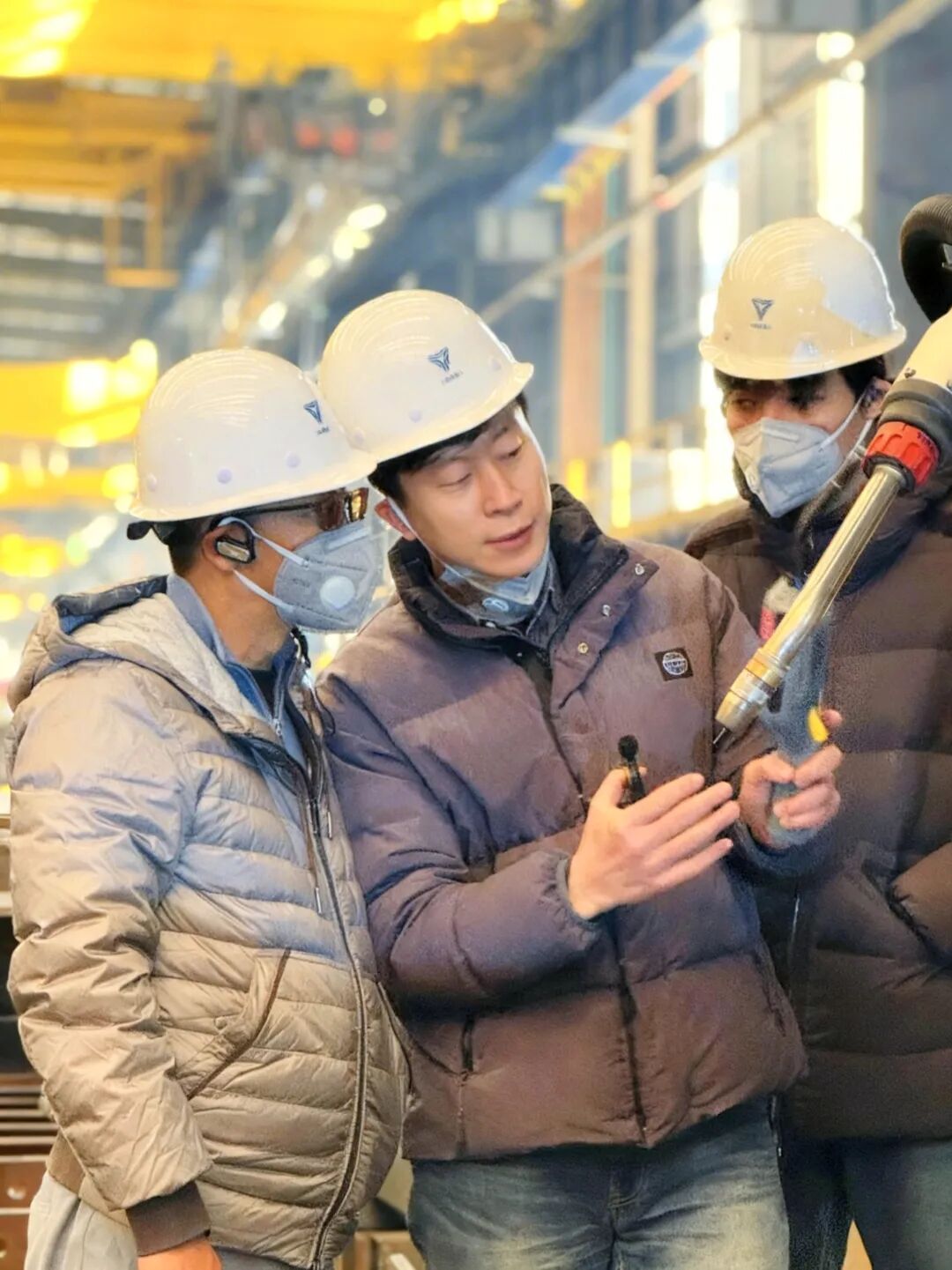
Qiao Zhongliang: You have to get hands-on. Go to the site to see how users use it and where the pain points are. You even have to switch to the customer's language system. For example, the "arc-striking rate" that welders often mention refers to how many hours a day the welding torch is lit, divided by the worker's working time. In the welding field this is a metric similar to "ROI," measuring a worker's efficiency. Going to the scenario in person gives you a better understanding of the importance of the "arc-striking rate," and our next step will be to work on getting robots to improve the "arc-striking rate."
AI Emergence: Although robots don't get tired like people and can guarantee the arc-striking rate, at this stage can the welding quality that robots controlled by embodied-intelligence models complete per unit of time reach the level of human workers?
Qiao Zhongliang: When it comes to the work quality of welding robots, there are mainly two metrics. First, the level of spatial generalization — whether the welding torch is "in position," i.e., whether the torch can reach the position that needs welding; currently this can be achieved in 80% of scenarios. Second, the level of welding operation and craft — that is, on the premise that the welding position and path are correct, whether the torch can complete the welding; in the scenarios we've entered, this can currently cover more than 50% of the work content of that scenario. Overall, although Xiaoyubot's robots still have a gap from the level of "master craftsmen of a great nation," they can reach the level of an excellent welder.
AI Emergence: How is embodied-intelligence robot welding achieved technically?
Qiao Zhongliang: We follow the route validated by Tesla FSD (Tesla's intelligent-driving model): end-to-end, data-driven. They control a car driving on the road; we control a robot performing dexterous operations.
AI Emergence: Welding does look a bit like "industrial autonomous driving" in path planning, but the difficulty seems to be not "how to get the route right," but "how to align the last few millimeters." What is the hardest part of your model training? How do you solve it?
Qiao Zhongliang: Not just in the welding scenario — in high-precision industrial embodied tasks, the difficulty lies in making the model know the real scale of the physical world. Specifically, we pre-trained a native multimodal 3D world model. The robot obtains multi-view images through pure vision, and the model outputs scaled 3D structure and physical properties — it not only knows "what this is," but also knows "how far it is from me." But this "sense of distance" is not innate. First, in the pre-training stage, we pre-train with a large amount of simulation data with real scale; then in the model post-training stage, we do SFT (supervised fine-tuning) with the large amount of high-precision sensor data accumulated in industrial scenarios, thereby obtaining a foundation model with the ability to understand real physical scale.
AI Emergence: In your 13 years at Xiaomi, you went through different industrial waves such as the internet, mobile internet and AI. What was your biggest takeaway? And how is that takeaway applied to your current venture at Xiaoyubot?
Qiao Zhongliang: At Xiaomi I mainly learned three things: hit products, the mass line, and the united front. Hit-product logic is the core characteristic of the internet industry, because the internet is about winner-takes-all. In plain terms, the concrete approach is to make the product and experience the best they can be, so that competitors can't break in the moment they take a look. But to achieve this level, you usually have to "drive yourself crazy," doing your utmost in every aspect — R&D, user experience, supplier management. The mass line means going deep among users, not building behind closed doors. This is especially important for industrial scenarios, because with phones we ourselves are the users, but industry is about solving problems for others — without going to the site you have no feel for it. The united front is uniting all forces that can be united. For example, like the Xiaomi ecosystem chain, supporting solution providers, sharing the supply chain, channels and brand, and ultimately expanding your own business scope through investment.
AI Emergence: Among the experience you've accumulated in the past, is there any path dependence you need to "avoid the pitfalls of" in this venture and future development?
Qiao Zhongliang: My biggest path dependence was that in the early days I unconsciously iterated on robot hardware as if it were an internet product — thinking I could ship a version first and then quickly change it. But hardware isn't like that: once a sensor's position is fixed, it means all data for the next two or three years will be collected based on this configuration. If you change a position, the data has to be spatially re-aligned and the model has to be retrained. We went down this detour early on too, pushing hardware the software way; the result looked fast, but the rework cycle actually made up all the time. Only later did we understand: hardware must be planned with a long-term strategy, thinking clearly from the start about what configuration can hold up over the next two or three years. With hardware, going steady beats going fast; only by going steady can you go far.
AI Emergence: Why did you name the company Xiaoyubot ("xiaoyu" means "light rain")? Does the meaning of "light rain" relate to your operating philosophy?
Qiao Zhongliang: In terms of entrepreneurial mindset, it's "flowing water doesn't vie to be first; what it vies for is to flow on endlessly" — I don't like big ups and downs; I care more about the steady development of the enterprise. Second, in customer philosophy, it's "moistening things silently" — I hope to continuously provide value to customers, but without vying for anything, naturally forming a fan-shaped scale.
AI Emergence: What do you think the endgame of this industry will be? What role does Xiaoyubot hope to play in it?
Qiao Zhongliang: Robots will be as widely applied as phones, and the industry endgame will form a layered division of labor — some doing applications, some doing brains, some doing bodies, some doing components. But right now the industry has two constraints: first, the foundational infrastructure is not sound; second, the business model is singular. What does "unsound infrastructure" mean? For example, new-force makers can build new-energy vehicles well in a few years because the three-electric system is complete; Musk took many years because those foundations were unsound at the time. A singular business model means software has not yet defined hardware, and it hasn't entered a Moore's-Law state of iteration. Everyone is competing over a few components, so the industry can accommodate very few companies, and none of them make money. Not everyone can research the foundation; someone has to build the business model. We hope to become one of those companies like Tesla to electric vehicles and the iPhone to phones, and the most important thing is to build up the foundation and the business model.