
Qiao Zhongliang on the "iPhone moment" of embodied intelligence100,000 units a year is the threshold
AI Translation Notice: This article was translated with the assistance of AI and is for reference only. In case of any discrepancy, the original Chinese text shall prevail.
On April 26, the "Joint Laboratory of Industrial Embodied Intelligence," jointly established by Beijing Xiaoyubot Technology Co., Ltd. and Beihang University, was officially unveiled. The laboratory simultaneously launched an "Industrial Embodied Intelligence Industry Alliance" initiative to jointly build the ecosystem and jointly set standards, injecting core driving force into the intelligent transformation and upgrading of Chinese manufacturing.
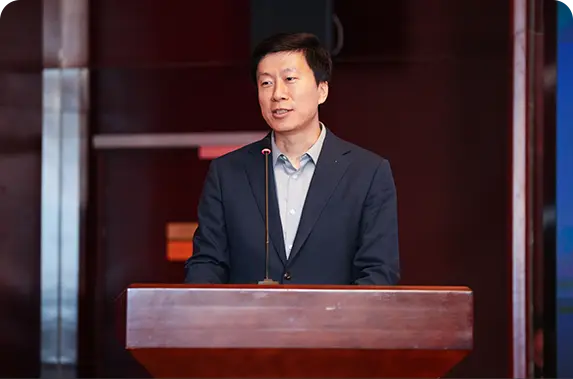
In the view of Qiao Zhongliang, founder and CEO of Xiaoyubot, the embodied-intelligence industry is currently in an entrepreneurial boom, but it lacks sufficiently good infrastructure. The whole industry needs enterprises that can create super hit products — like Tesla for electric vehicles and the iPhone for phones — to step forward and drive the industry chain. "Over the next decade, only fewer than 10 general-purpose embodied-intelligence enterprises worldwide will enter the finals," Qiao said, adding that annual shipments of 100,000 units will be the threshold for entering the finals.
Strengthening the moat of Chinese manufacturing with the embodiment dividend
At the founding site of the Beihang·Xiaoyubot "Joint Laboratory of Industrial Embodied Intelligence," Jiang Guangzhi, director of the Beijing Municipal Bureau of Economy and Information Technology; Xu Xinchao, district mayor of Beijing's Haidian District; Lyu Weifeng, vice president of Beihang University; Zheng Zhiming, academician of the Chinese Academy of Sciences; and Zhao Fengjie, director of the Intelligent Manufacturing Division of the First Equipment Industry Department of the Ministry of Industry and Information Technology, attended.
Zheng Zhiming pointed out that the difficulty of artificial intelligence lies in the deep fusion of data space and physical space; embodied intelligence is a must-contest ground in today's global technology competition, as well as a core strategic force for reshaping the underlying logic of national industrial manufacturing and developing new quality productive forces. The joint laboratory provides an excellent opportunity for industry-academia-research application.
Lyu Weifeng explained that the joint laboratory will focus on frontier breakthroughs, deepen the integration of industry and education, cultivate top interdisciplinary talent in embodied intelligence, and build a new benchmark for collaborative innovation across industry, academia and research.
Qiao Zhongliang is a Beihang alumnus. From 2010 to 2023 he worked at Xiaomi as head of Xiaomi Group's MIUI R&D, and was Xiaomi's first-ever fresh graduate and first fresh-graduate general manager. During his more than ten years at Xiaomi, rising from campus recruit to an executive managing more than 3,000 people, Qiao Zhongliang fully witnessed the growth and transformation of a hundred-billion-scale enterprise from 0 to 1 and then from 1 to 10.
With the sudden emergence of large models, Qiao Zhongliang's impulse for innovation and entrepreneurship could no longer be restrained. After some research, he set his sights on the embodied-intelligence field. Xiaoyubot' choice of the industry in Beijing's Haidian District also involved personal sentiment on Qiao's part.
"I studied, worked and started a family in Haidian, and have a special fondness for it; moreover, Haidian gathers talent, and the embodied-intelligence industry values talent density most, while the competent authorities value innovation and entrepreneurship; add to that the industrial synergy of the Beijing-Tianjin-Hebei region, which gives more scenarios for the industrial application of embodied intelligence," Qiao noted.
Xu Xinchao explained that Haidian District, as the core area of the national science and technology innovation center, has explored a "five parties, six forces" achievement-transformation model and proposed "three-circle investment" to accompany enterprise growth throughout the full life cycle — the enterprise-investment circle, the value-investment circle and the capital-investment circle — covering the complete cycle of an enterprise from startup to maturity.
Throughout world industrial history, due to labor costs and the profit-seeking nature of capital, industrial powers have all gone through a process of manufacturing outflow, and Chinese manufacturing faces the same risk. "The nation has proposed that manufacturing must be shored up, using the embodiment dividend to strengthen the moat of Chinese manufacturing — this is the highest strategic justice of industrial embodiment," Qiao said. The establishment of the Beihang·Xiaoyubot Joint Laboratory of Industrial Embodied Intelligence marks the deep cooperation between Xiaoyubot and academia in the field of industrial intelligence.
Annual shipments of 100,000 units is the threshold for entering the finals of embodied intelligence
"Industrial scenarios are inherently unsuitable for human labor," Qiao Zhongliang explained. The average age of Chinese welders is 45, with a shortage of more than 3 million; behind the fading of the demographic dividend, the essential reason is that industrial environments are harsh, and young people are unwilling — and should not have — to continue doing harmful work. "Liberating humans from harsh work is a cause of 'humanistic justice.'"
In Qiao Zhongliang's view, embodied intelligence must first start from industrial scenarios, using scale to drive cost coverage and improve productivity, then gradually move toward home and service scenarios. "Find a big market — without a big market there is no big hit product; and the big market must have pain points, without pain points there is no demand." Having looked across farming, forestry, animal husbandry, sideline production and fishing, he ultimately locked onto "turning, fitting, riveting, electrical and welding." Xiaoyubot' general-purpose embodiment path was decided to start from the welding scenario.
"The core logic of the field is to solve industry pain points," Qiao Zhongliang believes. The iPhone-level technology of embodied intelligence has not yet appeared, and there is no easy-to-use operating system; the industry needs a hit product — including an underlying operating system and an upper-layer data system — to drive the industry chain, otherwise every company starts from scratch and the industry cannot develop at scale.
"Over the next decade, only fewer than 10 general-purpose embodied-intelligence enterprises worldwide will enter the finals," Qiao Zhongliang believes. The lack of a super hit product is the core pain point of the current embodied-intelligence industry, and whether one can create a hit product will become the key metric for measuring embodied-intelligence enterprises: annual shipments of 5,000 to 10,000 units are the mark of the first tier, and annual shipments of 100,000 units are the threshold for entering the finals. To achieve this goal, Xiaoyubot chose industrial deployment as the path to reach the endgame of general-purpose embodiment.
"At present, an enterprise that buys a single robot recoups its cost in 10 months. Previously, one workstation required 4 welders, each with an annual salary of 120,000 yuan; now a worker with no welding experience can manage 4 robots, working only 9 hours." Qiao Zhongliang did the math: using scale to lower costs is equivalent to technological equality — selling a high-quality product at an affordable price gives it the chance to become a hit.
Industry needs not only humanistic care; at the same time, technological evolution has hit a ceiling. Qiao Zhongliang explained that industrial automation applies to standardized products such as automobiles and consumer electronics, but in non-standard scenarios such as shipbuilding and aerospace, it can no longer meet the needs of productivity progress. "Transcending traditional automation technology is the technological justice of industrial embodied intelligence."
Since the beginning of this year, the financing fever for humanoid robots has not abated, while embodied intelligence for industrial applications has no running or dancing "teaching props" to go viral. Qiao Zhongliang believes that "the difficulties of entrepreneurship in different directions must all be experienced sooner or later. Whether general-purpose or another route, in the end it is a matter of reaching the summit via the north slope or the south slope — descending from the top via the north slope, or entering via one scenario on the south slope first, validating, then expanding."
"There is no longer a debate between vertical models and large models — they are all large models. The difference lies in whether the data is abundant enough and good enough. Xiaoyubot's foundation model is deeply rooted in scenarios, truly forming a scenario data closed loop and data flywheel, and producing sales results recognized by users," Qiao Zhongliang said.
At present, Xiaoyubot' seed round received investment from Xiaomi Group and Beihang University professor Wang Tianmiao; its angel round attracted investment from BAAI (Beijing Academy of Artificial Intelligence) and Xiaomi co-founder Li Wanqiang. It has successively received multiple rounds of investment from the Beijing Xinchan Fund, iFlytek, Didi, Highlight Capital, CMB International and the Moutai Fund.
"We are more attractive to industrial capital — they are the patient capital in this industry. This industry has a very long cycle and extremely high requirements for talent density, so the capital demand is naturally large," Qiao Zhongliang believes. When a marathon has just begun, one should not run the first half at a hundred-meter-sprint pace, but must allocate one's speed across the whole course.