
Creating the embodiment dividendXiaoyubot tells two stories in three years
AI Translation Notice: This article was translated with the assistance of AI and is for reference only. In case of any discrepancy, the original Chinese text shall prevail.
Embodied intelligence has always advanced amid controversy.
From the choice of a single component to the outline of the endgame, this industry has never lacked non-consensus — one could even say that the controversy born of non-consensus is the industry's starting point. But if you were to rank the controversies of the past two years, the biggest word is undoubtedly "bubble."
This is not baseless. After embodied intelligence became popular in 2024, all sorts of companies with all sorts of motives poured in, leading more and more people to believe that this is a prematurely ripened industry, an industry with inverted value. To call it a "bubble" is not an exaggeration.
If we trace the source of this argument, it can be attributed to two interrelated dilemmas: near-term value is too thin, and the long-term pie is drawn too large.
In the near term, the vast majority of embodied-intelligence companies have yet to find a real paying scenario. No one knows where these robots will go to work tomorrow; forums offer only vague summaries of "industrial" and "commercial," and few companies can point to a specific task flow that generates positive returns.
In the long term, most companies' visions are the same story: general-purpose embodied intelligence will reshape everything about human production and life. This endgame narrative is so grand and so alluring that it actually makes it hard to see the road underfoot. An industry with only a distant mirage and no supply stations along the way will not get far before people start to fall.
The core of the problem is: where is the value anchor?
What is an anchor? It must have two attributes: visible returns in the near term, and certain room for growth in the long term. The former lets a company generate its own blood and strengthen its resilience; the latter lets the team and investors still believe in the road ahead in the hardest moments. Without the former, the company cannot survive to the long term; without the latter, the company is not worth surviving that long.
Across the entire embodied-intelligence field, the companies that truly grasp both anchors at once can be counted on one hand.
Xiaoyubot is one of them.
At the 2026 Global Digital Economy Conference, Xiaoyubot' founder Qiao Zhongliang stepped onto a public stage for the first time. What he brought was a welding robot that does not look "sci-fi" at all, and a standard workstation with a starting price of 169,800 yuan. "Xiaoyubot has firmly chosen industrial deployment — heavy industry within industry, and the most hardcore welding within heavy industry," Qiao said in his speech. Xiaoyubot' products have already been deployed in more than ten frontline factories, covering multiple heavy-industry scenarios such as building steel structures and shipbuilding.
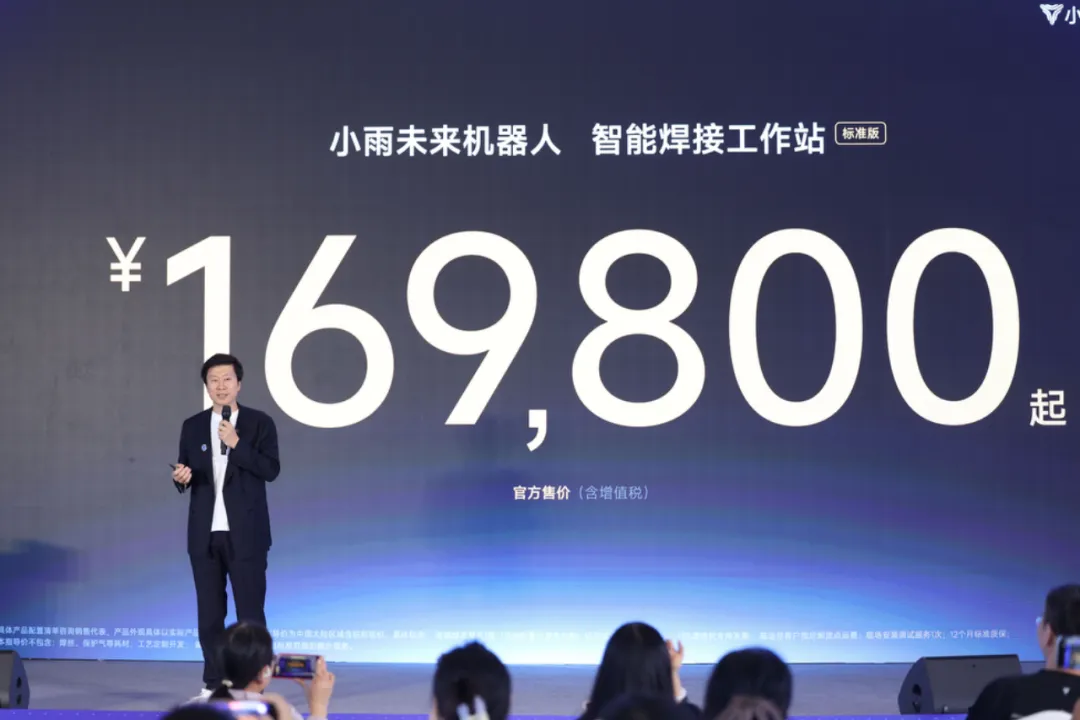
But Qiao Zhongliang is clearly not content with merely doing an "equipment-selling" business. In his speech, he proposed the concept of the "embodiment dividend" for the first time: using embodied intelligence to build a large-scale, silicon-based labor force and free workers from harsh environments.
This is a classic two-layer narrative of "near-term returns, long-term expectations." In the near term, Xiaoyubot sells welding robots that enter factories one by one, generating real revenue and real customer-feedback data; in the long term, these steadily accumulating 100,000 hours of real industrial multimodal data are universal nutrients that add certainty to subsequent scenario expansion.
On top of that, there is a general-purpose brain as the foundation, and this brain drives bodies of different forms — it can be a welding robotic arm, it can be a quadruped robot, and in the future it can be a humanoid.
The first welding robot is only the first step, but this step is planted on real ground. Xiaoyubot' choice is, in essence, respect for the laws of technological development. It is not that the company does not yearn for the endgame of general-purpose embodied intelligence, but that it clearly recognizes the road to the endgame must be paved by frontline production scenarios.
01 Finding the value anchor through scenario symbiosis
The first product is a welding robot, and this choice itself is worth pondering.
In the debate between the "humanoid spectacle" route and the "industrial deployment" route, the former clearly better suits outside aesthetics — easier to finance, easier to make headlines, easier to draw crowds at trade shows. But Xiaoyubot chose the latter, because the latter is closer to a sense of certainty. Humanoid robots are still answering "what can you do," while welding robots can already answer "what is my value," and hold up better under scrutiny.
Yet "industry" is a very broad concept, hiding tens of thousands of trades beneath it, each with its own working environment, skill threshold and logic of replacement. The task left to embodied intelligence is not "pick an industrial scenario," but to find the trade whose real demand is hard enough and whose long-term development can support a larger vision. If even one of these prerequisites is missing, the product becomes a stranger in the scenario — it gets in, but cannot blend in.
Welding happens to satisfy all three conditions at once. The shortage of welders has stayed above 3 million for years, which means the product has a real business loop the moment it lands, rather than being a "bonsai project." And welding is a mature workflow that appears in many industrial scenarios, so the demand always exists.
But what Xiaoyubot delivered is not a welding robot in the traditional sense.
On July 2, 2026, in the "debut showcase" segment of the Global Digital Economy Conference, Xiaoyubot released its first industrial embodied-intelligence product — the Xiaoyubot Future Robot. Qiao Zhongliang summed the product up in eight characters: "Hardcore work, hardware maxed out." It is the industry's first industrial embodied-intelligence welding robot, maxing out the configuration across the three core links of robotic arm, vision and compute to form a complete industrial welding embodied-intelligence system.

First, its "body." The Xiaoyubot Future Robot uses a Universal Robots arm, the highest-precision player among the world's collaborative robots. After several hours of continuous work, facing workshop temperature swings and the thermal expansion and contraction of metal, its landing point can still stay steady at the sub-millimeter level. Its "eyes" are provided by a Mech-Mind welding-dedicated 3D camera, paired with the Xiaoyubot Runwu multimodal perception algorithm, stably outputting sub-millimeter point clouds. This overcomes industry-wide challenges such as reflective metal surfaces, incomplete recognition of V-shaped grooves and dynamic tracking of multi-layer weld seams, while also resisting on-site interference such as arc light and smoke, providing precise, continuous path guidance for the welding robot. On the compute side, it is equipped with the NVIDIA Orin platform, a hard capability proven in autonomous driving; Xiaoyubot also announced a strategic partnership with D-Robotics and will in the future carry the domestically made Sunrise S600 flagship compute platform.
The Xiaoyubot Future Robot also supports multiple arm spans: a short arm span can be used in cramped ship cabins, and a long arm span can be paired for building steel structures. There is no longer the problem of a robot's operating radius failing to match the environment, nor any need to find the "greatest common divisor" of operating paths — rapid deployment is possible in any scenario.
From chips to perception and operating hardware, the configuration shows Xiaoyubot' sincerity. But if one understands it only at the level of hardware stacking, one will miss what truly deserves attention about this product.
Hardware solves the problem of "being able to weld well." What truly sets this product apart from traditional industrial robots is its underlying technology: a world model named Runwu, a hardware platform named Xirang, and an interaction tool named the "positioning pen." The hardware platform and the positioning pen together answer another question: how to make the robot not just do the work, but coexist with the scenario.
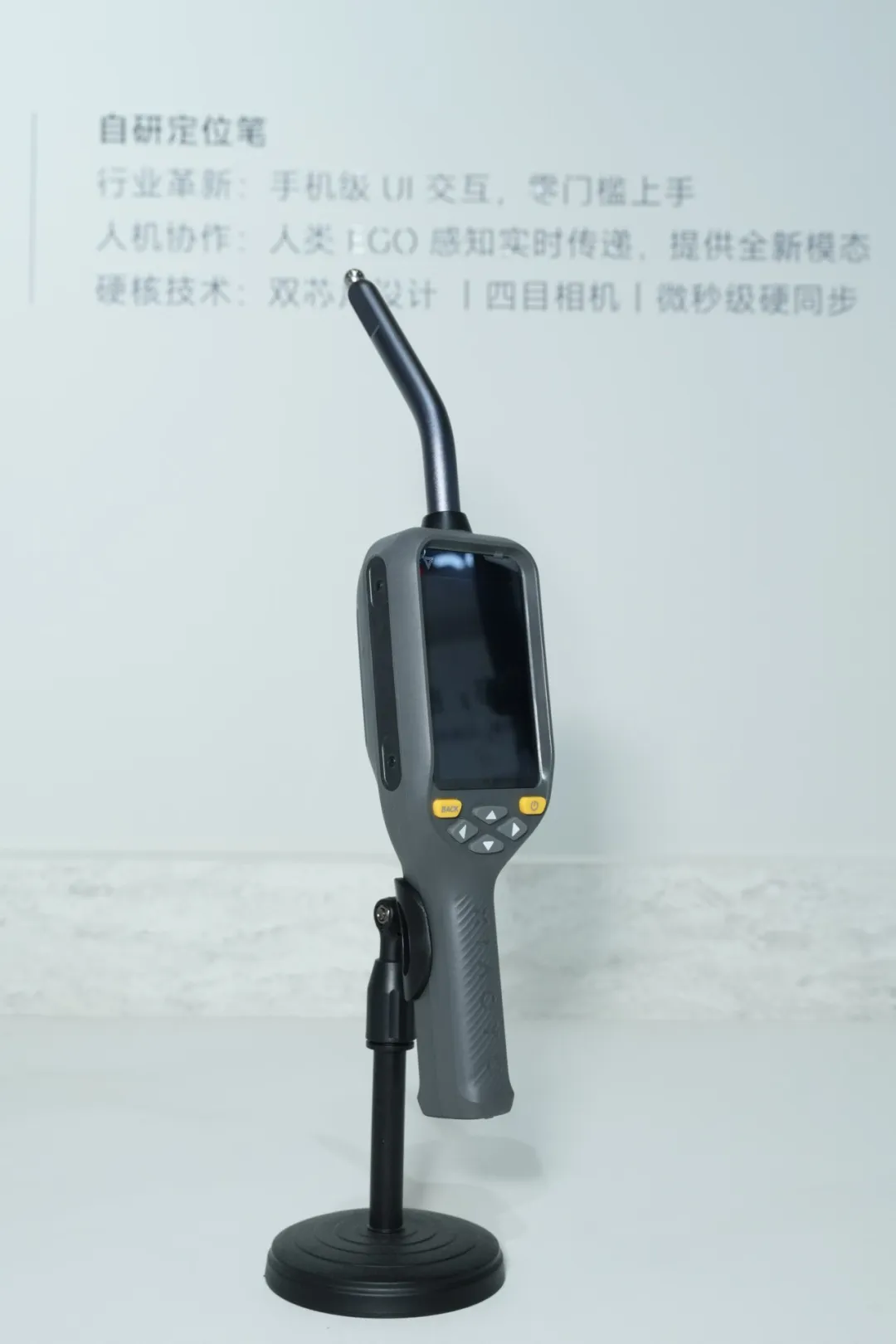
The positioning of the Xirang hardware platform is very clear: the "infrastructure" of industrial embodied intelligence.
Industrial robots have a chronic ailment: the whole machine lacks a unified architecture, wiring is complex, communication latency is high, and expanding a single function often affects the whole system — every company reinvents the wheel. The Xirang platform breaks this deadlock with three things: first, introducing a top-tier compute foundation so that edge-side model inference and action generation maintain high-frequency, real-time decision-making; second, a proprietary domain controller that divides the whole machine into standardized functional domains, directly connected via a high-speed bus, with a clear, plug-and-play architecture; third, 5G multi-card aggregation to ensure that remote monitoring, teleoperation takeover and data return are always online.
Its significance goes beyond this one welding robot. Whether robotic arm, quadruped or humanoid, as long as it connects to Xirang — with the deployment toolchain and a small amount of real-machine data — it can be taken over by the brain. In other words, Xirang is a foreshadowing that Xiaoyubot has buried in the welding scenario: today it drives a welding arm, tomorrow it may be products of various forms, with the same underlying architecture expanding laterally, no need to rebuild from scratch.
The emergence of Xirang is the outward expression of Xiaoyubot' insight into industry pain points; it solves collective, future problems. What best embodies Xiaoyubot' rootedness in the scenario right now is the positioning pen.
Although more products entering industry currently favor voice interaction, factory workshops are full of machine noise — people have to shout even face to face — so voice interaction is inherently unsuitable. The positioning pen made by Xiaoyubot combines a four-eye surround camera and IMU inertial navigation, a dual safeguard of vision plus inertial navigation. A worker gently points the pen at the workpiece, and the spatial position, operation sequence and process intent are instantly conveyed to the robot. Paired with a phone-grade UI, a novice worker who has never touched a robot can go on the job directly in a short time.
What does this mean? It means the usage logic of this product is not "make workers learn to operate a machine," but "let workers hand their intent directly to the machine in the way they know best." It does not require workers to change their work habits to adapt to the machine; it simply embeds into the workflow workers already have.
This is the hardware foundation of scenario symbiosis.
The product is not abruptly inserted into the scenario to replace people, but embedded into the scenario's workflow and data flow, growing together with the scenario. Workers collaborate with the robot in the way they know best, and every piece of data the robot generates during welding flows back in real time through the Xirang platform into the world model, which iterates accordingly — so the next move is more accurate, more stable, smarter. The scenario feeds back to the system, and the evolved system integrates even more deeply into the scenario, forming a self-reinforcing loop.
Here, the product is not forced into the scenario, but grows naturally out of the scenario's needs. It takes root in the scenario and grows tall together with it. Only such a product is qualified to talk about long-termism.
02 Technology cannot be confined to the present — foresight defines the moat
After hearing the account that can be calculated clearly, let's look at that long-term "pie."
In his speech, Qiao Zhongliang mentioned a term — "One Brain, Multiple Forms": first polish a general-purpose brain, then let it drive bodies of different forms. This is the long-term space for certainty that Xiaoyubot offers.
This brain is called "Xiaoyubot Runwu," a world model. But to understand its value, we must first answer a more basic question: why, after thirty years, can a traditional industrial robot still not outperform a master craftsman with ten years of experience?
The answer is simple. An industrial robot is essentially not working — it is merely repeating actions. But before a master craftsman reaches out, he has already run through the action, force and rhythm in his mind, and can get the hang of a new part in half an hour. The gap between the two is not speed, not precision — it is intuition. It is the causal predictive ability about the physical world that a person accumulates through long immersion.
What Xiaoyubot Runwu aims to do is to give the robot this industrial intuition for the first time. It does not simply recognize images, nor mechanically reproduce action sequences; before the robot actually acts, it first "sees the future" internally, predicting how the physical environment will evolve after a certain action is executed, and then finds the optimal control path in advance. It is a bit like Doctor Strange in the Marvel films, who has already played out millions of outcomes in his mind before making a move.
The main nutrient of this intuition — or brain — comes from data. This is the core reason the model can deeply understand industry. This data is not crawled from the internet, nor recorded in a lab, but grown from real welding smoke, from real scenarios. It contains rich representations of the physical world. In other words, Xiaoyubot Runwu has not "studied" industry — it has "done" industry.
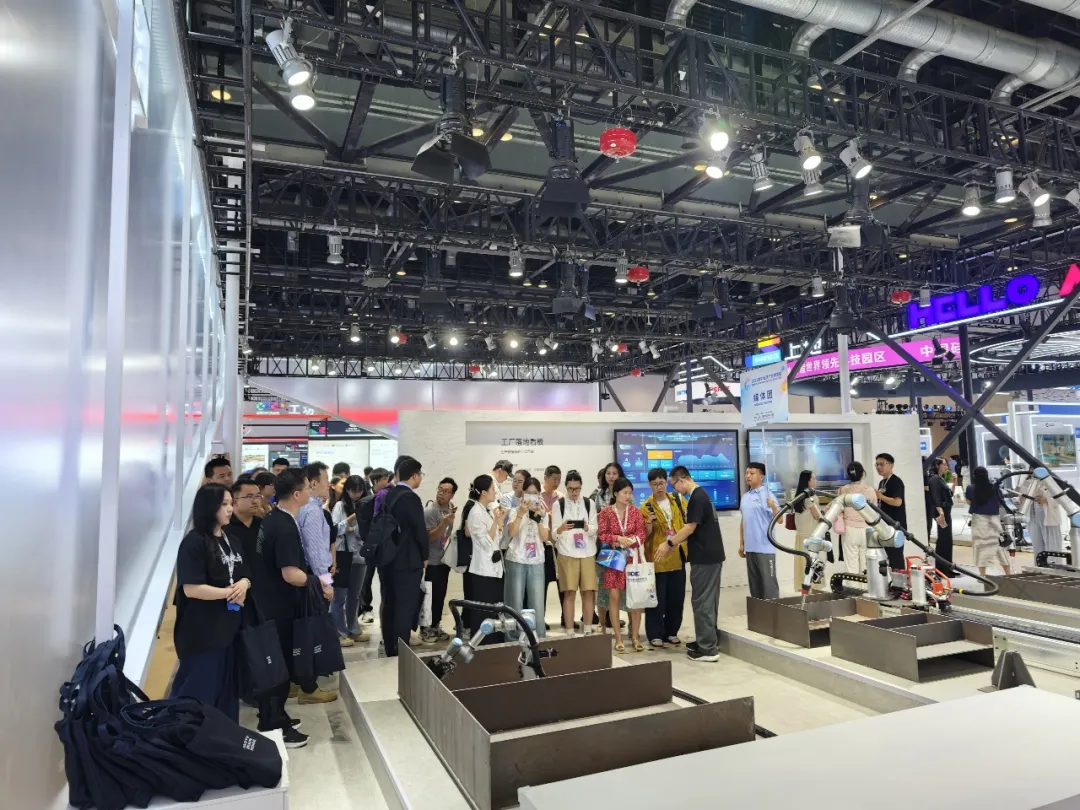
With data, you also need a model architecture that can efficiently extract data and compress the physical laws within it. The architecture developed in-house by Xiaoyubot Runwu is one of the earliest 4D world models in China to complete closed-loop validation in real industrial scenarios.
4D adds the dimension of time on top of three dimensions. A robot must "see" the task environment in three dimensions, but space alone is not enough — everything at an industrial site is changing: during welding, metal melts and solidifies, and the robot's viewpoint keeps switching as it moves. So time is introduced. Xiaoyubot Runwu takes the continuous signals of physical states over time and the robot's current action as inputs, and predicts in the latent space: after the robot executes a certain action, how will the physical state of the world change?
Finally comes the most pragmatic part of Xiaoyubot Runwu — and the part most different from the industry.
Xiaoyubot has drilled to the very end in an extremely complex welding scenario, then fully connected the loop of training, online data return and rapid real-machine deployment of the model. Every minute that each Xiaoyubot Future Robot works in a factory, it generates data in real time; the model iterates rapidly based on the latest real feedback, and the new version is quickly deployed to the real machine.
Two hundred hours of real data drive this flywheel every day — a rather considerable figure, meaning the model is recalibrated by real industrial physical laws every day.
Connecting this flywheel means that when Xiaoyubot wants to expand laterally in the future to grinding, assembly, inspection and even more complex industrial scenarios, it no longer needs to start from scratch. The world model's understanding of physical laws can be transferred, the data-return infrastructure can be reused, and the engineering methodology validated in a single closed loop can be replicated. Welding is the first real-world deployment of this brain, but it is definitely not the last. Once this brain is proven reliable, proven able to self-evolve, and proven able to continuously create economic value, whether it drives a robotic arm or a humanoid robot becomes merely a choice of "body."
This is probably the true meaning of "One Brain, Multiple Forms": first put in the dumbest effort to train a brain, let it truly run through, truly make money and truly evolve in the hardest scenario — and then you will find that the doors to other scenarios have already quietly opened.
Technology cannot be confined to the present. The present is a welding workstation at 169,800 yuan apiece, the mass-production delivery in factories, the 200 hours of real data flowing back each day. But looking ahead, this brain — which has already completed closed-loop validation in real industrial scenarios — is Xiaoyubot' widest moat.
03 Attitude is the most fundamental proposition
Xiaoyubot has been established for more than 1,200 days, and this is its first public appearance.
If you have a sense of this industry's timeline, you will know what this means. From 2023 to 2025 were the three most feverish years for embodied intelligence in the capital market: financing news climbing ever higher, humanoid-robot launch events one after another, backflips at trade shows more dazzling each time. In that period when everyone feared being forgotten, many companies chose a survival strategy — grab the microphone first and make the market remember their name.
Xiaoyubot did not join this bustle. Its founding team comes from Xiaomi, Huawei and ByteDance; core members led the Xiaomi software system platform, the "Xiaomi Brain," the mass production of hundreds of millions of phones, and frontline R&D of top large models. The founding team blends AI, software, hardware and large-scale mass-production experience. R&D staff account for more than 80% of the total. Among them, more than 60 focus on model algorithms, with an average age of 28, all graduates of top universities at home and abroad.
Such a team with a glittering résumé could, if it wished, have taken the stage earlier. In this industry that values pedigree, they do not lack the fundamentals to draw attention.
But they chose silence.
In those three silent years, they spent their time on "dumber" things: burrowing into factories, accumulating those 100,000 hours of real data amid dust, noise and arc light; developing the world model, hardware platform and interaction tools in-house from the ground up, rather than buying off-the-shelf solutions to integrate.
This is not modesty — it is an attitude. When everyone else was answering "what do you think of me," Xiaoyubot chose to first answer "have I actually gotten the job done."
More concretely, the Xiaoyubot that made its debut delivered a complete solution — not a breakthrough in a single technology, not a prototype that looks cool but no one knows how to sell, but an entire pipeline, all developed in-house, all validated in a closed loop. On China's embodied-intelligence track, among the two or three hundred companies, those that can present such a complete technology stack and product form at this point in time can be counted on one hand.
This "do it first, talk later" way of working better fits the true rhythm of embodied intelligence, which requires the polishing cycle of hardware, the long-cycle accumulation of data, and the repeated trial-and-error and calibration of the model in a real physical environment. Xiaoyubot' silence is, in essence, respect for the laws of this industry. In the plainest way, it tells the industry that in the matter of embodied intelligence, attitude is the most fundamental proposition.
The posture in which you enter determines how far you can go. Those who chase the trend scatter when the trend passes; those who bury their heads and lay a solid foundation have already built to the third floor by the time the wind comes.
For an industry that is still young, this matters more than any backflipping robot.