1,000 days after leaving XiaomiI founded a robotics platform company
AI Translation Notice: This article was translated with the assistance of AI and is for reference only. In case of any discrepancy, the original Chinese text shall prevail.
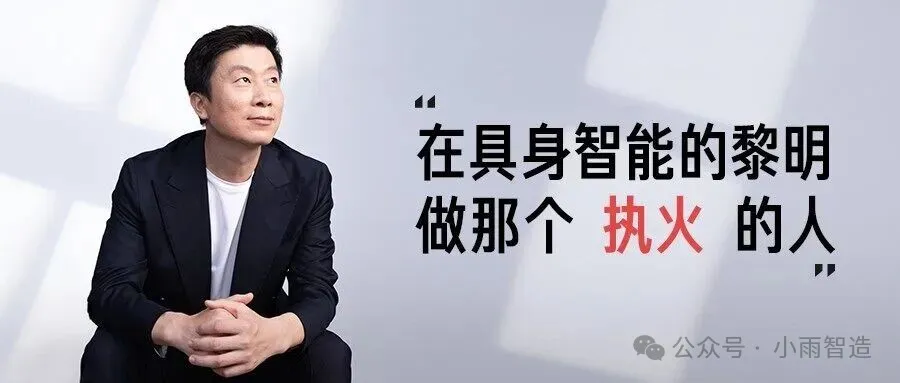
Hello everyone, I am Qiao Zhongliang, founder of Xiaoyubot. This is the first article on the "Xiaoyubot" official account. In opening this account, we want to formally say hello to everyone and introduce who Xiaoyubot is, what Xiaoyubot is doing, and why we are doing this.
This article is actually the first time I have systematically written down my thoughts of these years. In 2023, I left Xiaomi and founded a general-purpose embodied company — Xiaoyubot. Over three years, we have fallen into many pits and also received a lot of help, ultimately making products that our customers trust and that we ourselves are proud of, and becoming ever more firm in the path we originally chose. Taking this opportunity, I want to share relatively completely our thinking and practice on the path of rebuilding the industrial foundation. If you are also full of expectations for the future of China's intelligent manufacturing, I hope these words can offer you some real industry perspective.
In 2010, right after graduating with my master's degree, I joined a mobile-phone startup. At the time, the company had been established for only two months, and I was their first fresh graduate. This company was Xiaomi. Here, I participated in and witnessed the birth of a Fortune Global 500 enterprise, and this experience also spurred me to want to realize my personal ambitions. I graduated from Beihang University's School of Computer Science and have always yearned for artificial intelligence. At the end of 2022, the moment I saw ChatGPT, I knew the age of artificial intelligence had arrived. So in 2023 I left Xiaomi and founded Xiaoyubot.
I. Who is Xiaoyubot
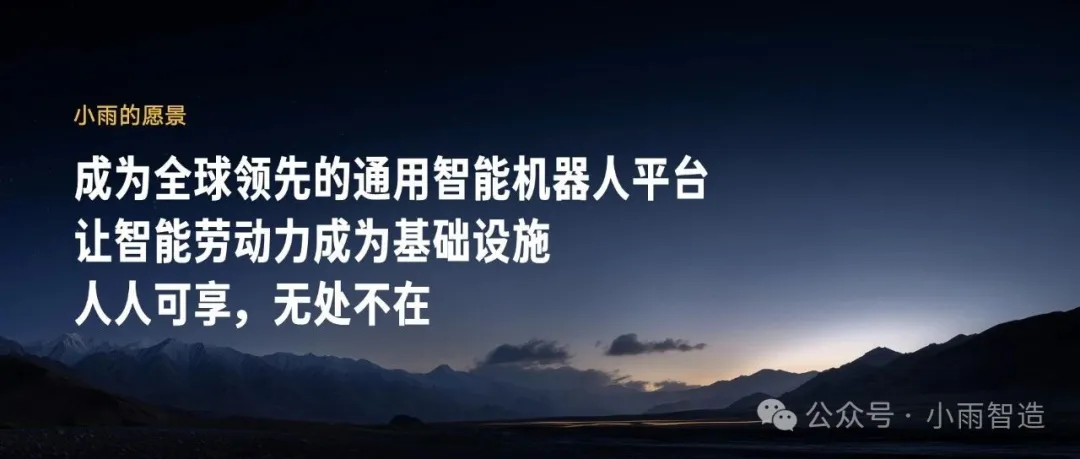
What kind of company is Xiaoyubot? We are a general-purpose embodied-intelligence company. Our vision is to "become the world's leading general-purpose intelligent-robot platform, making intelligent labor an infrastructure — available to everyone, everywhere."
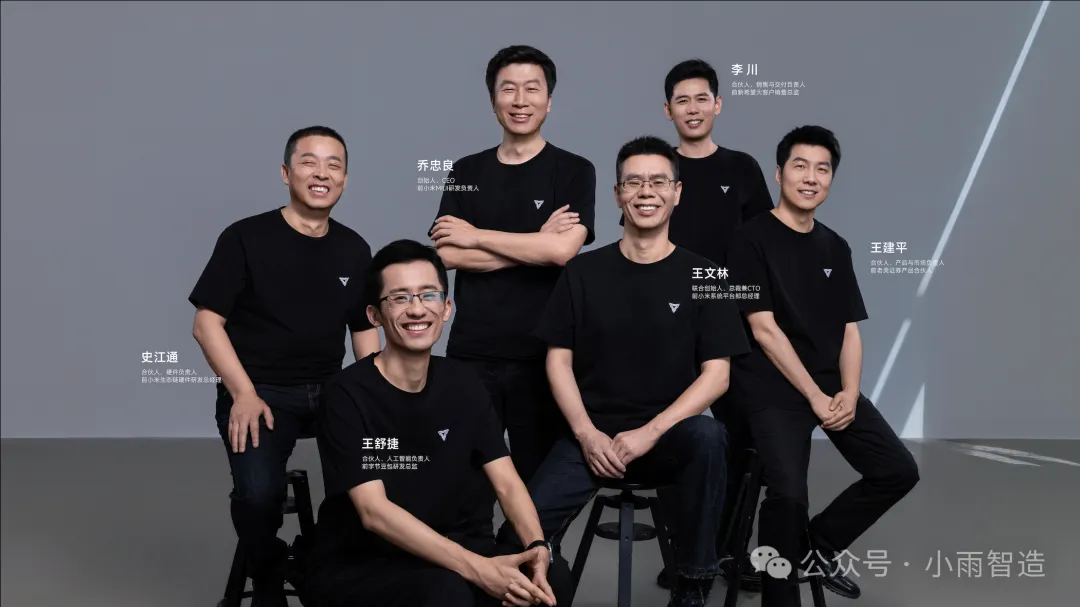
Starting a business is first of all founding it on technology. To achieve such a goal, you must have a very strong founding team, and Xiaoyubot has gathered a large group of elite talent. Our entire partner team now has six people; among them, I was head of MIUI R&D at Xiaomi. Co-founder and CTO Wang Wenlin was formerly general manager of Xiaomi's software system platform department and led the development of the "Xiaomi Brain." Partner Shi Jiangtong was Xiaomi's first structural and structure-department manager in the phone division and manager of the ecosystem-chain R&D department, having truly run the manufacturing and mass production of hundreds of millions of phones. Most of our startup team have professional backgrounds at Xiaomi, Huawei and ByteDance.
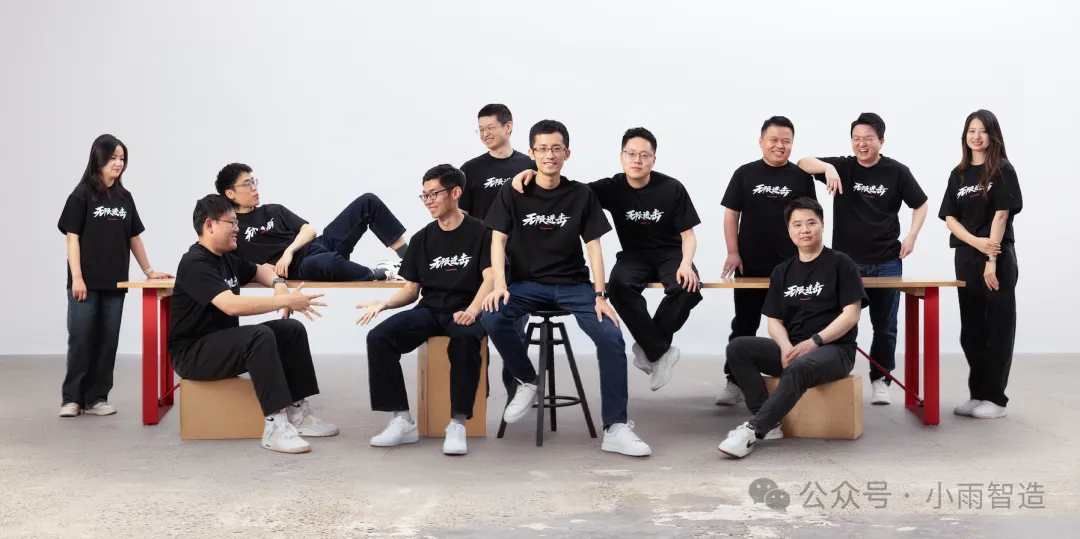
As of the first quarter of 2026, our team has about 120 people, of whom around 60 work on model algorithms, all graduates of well-known universities at home and abroad, with an average age of about 28 — the youngest being 24 — a highly youthful team. Over the past three years, we have dedicated ourselves to building a "One Brain, Multiple Forms" general-purpose robot brain and industrial application products, applying for more than 80 invention patents, and also obtaining qualifications and titles such as "Beijing Specialized, Refined, Distinctive and Innovative SME." At present, we first focus on the deployment of intelligent-welding scenarios; our products have been applied by several strategic customers and have reached the mass-production delivery stage.
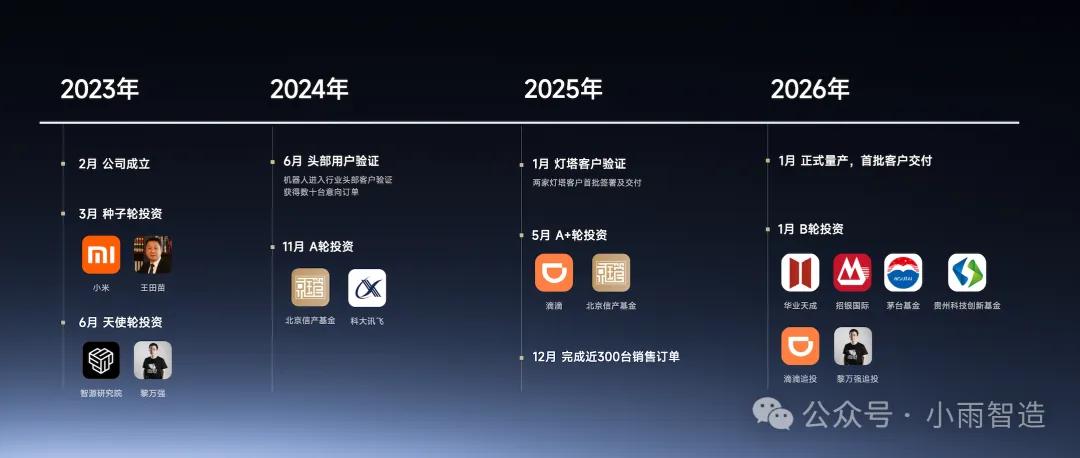
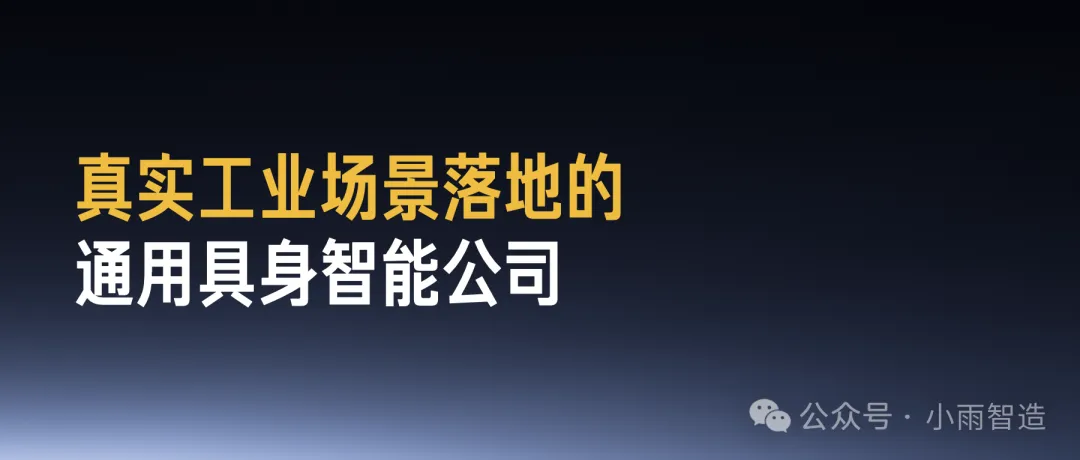
Our undertaking has only just begun, but it has already received strong support from industrial capital and government-backed funds. Our seed round received investment from Xiaomi Group and Professor Wang Tianmiao; our angel round attracted investment from the Beijing Academy of Artificial Intelligence (BAAI) and Xiaomi co-founder Li Wanqiang. Since then, we have successively received multiple rounds of investment from the Beijing Xinchan Fund, iFlytek, Didi, Highlight Capital, CMB International, the Moutai Fund and others. Why is everyone optimistic about Xiaoyubot? The core reason is that Xiaoyubot is general-purpose embodied intelligence focused on deployment in real industrial scenarios. To explain this, we must first see clearly the current state of the industry.
II. How to reach the endgame?
Right now, the industry can be said to be very lively. Today China has at least two or three hundred embodied-intelligence companies. Among them, some make model brains, some make robot bodies, and some do data collection. Does this scene seem familiar? The internet, mobile internet and new-energy vehicles have all had it. Whenever a new technology appears, there is bound to be a hundred boats contending, a thousand sails competing, finally forming a stable pattern. Before everyone is the same question: how to reach the general-purpose embodied endgame? I summarized it in one sentence: the industry is competing along "two routes" around "one pain point."
First, one pain point. As I said, there are already many companies doing models, bodies and data, and we have seen quite a few doing very well, especially the robot-body companies that have developed rapidly in the past two years. But the infrastructure of the whole industry — that is, the foundation capabilities — is still far from sound; for example, a general-purpose brain and a general-purpose controller have not yet appeared. Compared with consumer electronics and new-energy vehicles, the supply chain of embodied intelligence is also far from mature — because the whole industry has no super hit product. Just as the iPhone was to phones and Tesla to electric vehicles, only under the stimulus of a super hit product can a supply chain move toward maturity.
A super hit product is the ultimate ticket for embodied intelligence. Today, more and more entrepreneurs and investors recognize that the iPhone moment of embodied intelligence is still far from arriving. A super hit product is the biggest pain point right now. Whoever pulls this off has obtained the ticket to the endgame of embodied intelligence. My personal judgment is that for an embodied-intelligence company, annual shipments of 5,000 to 10,000 units are a necessary condition for entering the first tier; annual shipments of 100,000 basically lock in the ticket to the finals, because this is the starting threshold for a super hit product. More importantly, once a company that makes a super hit product appears, the industry landscape will rapidly converge.
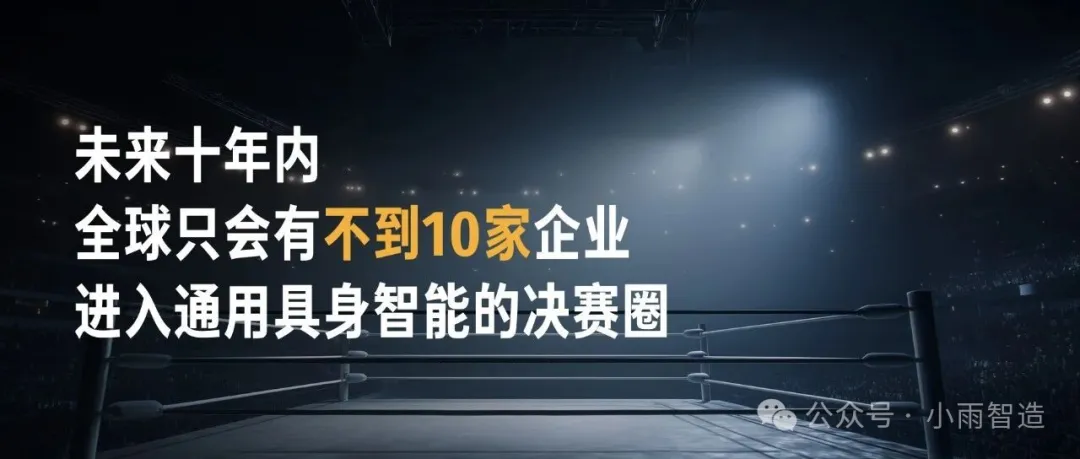
In the next 10 years, there may be fewer than 10 enterprises worldwide that enter the finals of general-purpose embodied intelligence. Xiaoyubot of course wants to be among them, and this is also the goal of all embodied-intelligence enterprises. But with the goal set, what kind of route do we use to get there? Over the past three years, we have clearly observed that the industry has formed two routes. One is splendid and flower-strewn — I call it the "humanoid spectacle" route; the other quietly toils away — I call it the "industrial deployment" route. Of course, the two routes are not diametrically opposed. Industrial deployment does not exclude humanoids, and some scenarios even require humanoids; the various capabilities that humanoid robots display today will surely have a use in the future. Moreover, the first route already shows a tendency to move closer to the second — because people increasingly find that humanoid robots still have many problems, such as battery life, ROI returns, scenario adaptation, and so on. These problems are only discovered in concrete deployment scenarios.
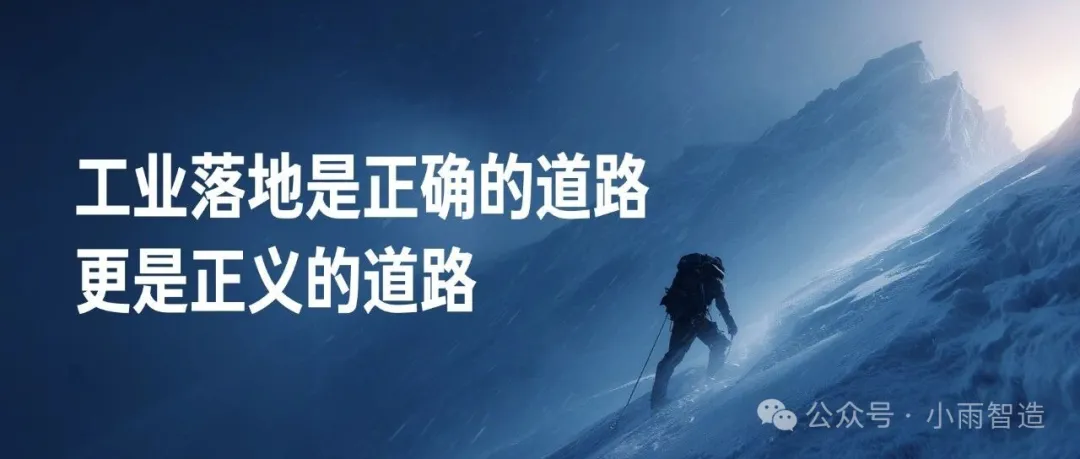
As everyone knows, over the past three years the former route has been the mainstream narrative of the industry. Xiaoyubot, however, firmly chose to do industrial deployment — and heavy industry within industry, and welding, which has an extremely high technical threshold within heavy industry. Our work scenarios are not in Beijing, Shanghai and Guangzhou — the most advanced part of Chinese manufacturing that surfaces above water — but in third- and fourth-tier cities, the deepest part of Chinese manufacturing submerged underwater; our robots are not on a stage, with no lights and no music, but in factories, working amid dust, noise and arc light. In this way we held to our original aspiration, unaffected by the mainstream narrative, and worked alone for three years, going from validation to mass production, building a reputation in users' hearts and becoming pragmatically deployed general-purpose embodied intelligence. Why did we choose a hard road? Because compared with difficulty, we care more about whether it is right. At Xiaoyubot, I often say: the first battle is the decisive battle; the prelude is the finale. We begin with the end in mind, seeking the path to general-purpose embodied intelligence, ensuring that from Day 1 we tread the right road.
First applied to production, then popularized in daily life. Looking back at the history of human technology, there is a phenomenon: major technological innovations are always first applied to production, then popularized in daily life. The steam engine was first sent into mines to pump water, then entered textile mills, and only finally trains and steamships; the computer, at its birth, was a behemoth for military computation and enterprise data processing, and after several decades became the smartphone. Because innovative technologies, in their early stages, are all expensive and imperfect, but extremely in need of capital and promotion. Daily-life scenarios are very complex, consumers are extremely price-sensitive and demand out-of-the-box readiness; production scenarios are relatively controllable — as long as the core pain point can be solved, enterprises are willing to pay. By comparison, only industry is best suited to be the "sponsor of the great voyage" for innovative technology. We think general-purpose embodied intelligence is the same. The road to general-purpose embodied intelligence must be paved by frontline production scenarios. First, this is a blue-ocean market, enough to run through a commercial closed loop; second, it is also a huge data gold mine, conducive to driving the data flywheel to turn in the right direction; finally, it is very suitable for giving birth to a super hit product that leads the entire industry. Therefore, when the industry is full of all kinds of clamor, we chose a harder road that better conforms to the laws of technological evolution. We think this is a right road, and even more a righteous road.
III. This is a righteous cause
Why a righteous road? Because developing industrial embodied intelligence has a natural righteousness, mainly reflected in three points.
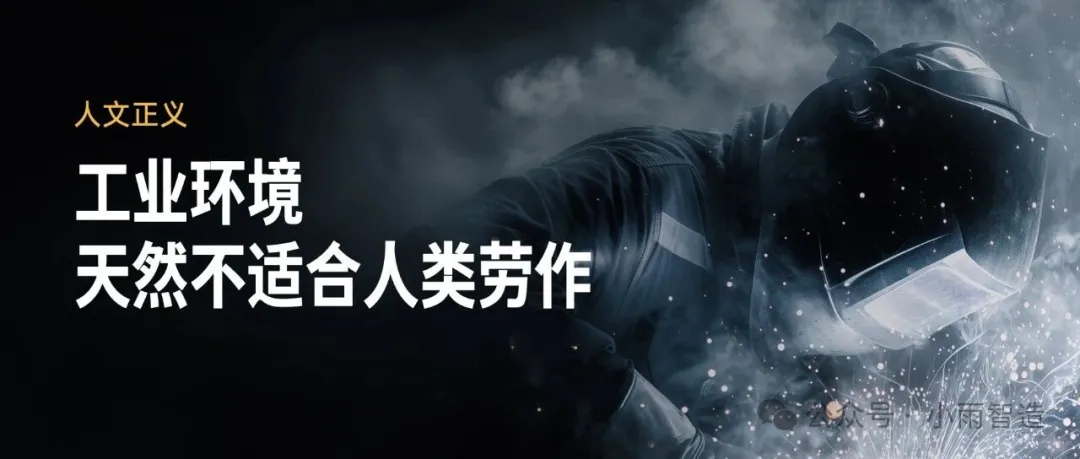
Humanistic righteousness: liberating humanity from harsh work. First, from a people-first perspective, industry is naturally unsuited to human labor. Xiaomi has several smart factories in Beijing, and the environment inside is very good. But it is done so well that it is enough to make us forget the true face of industry. Real frontline factories are not like this, especially the heavy industry that supports all of Chinese manufacturing. There, it is hot in summer, bitterly cold in winter, with dust all year round, noise, the danger of falling heavy objects, and so on. None of this is suitable for humans to work in, and the evidence is that people are voting with their feet. For example, welders, called the tailors of industry, are the job type with the largest number counted by the Ministry of Human Resources and Social Security, but the average age of this group is 45, with a shortage of over 3 million. Clearly, young people are no longer willing to do this work. Some may say this is the demographic dividend expiring. But I don't think so; even if there were still a demographic dividend, do we really want the next generation to take up such work? Our parents' generation mostly did physical labor — going to the fields, entering factories, holding up a family at the cost of their health. Their lifelong dream was for the next generation to receive a better education and stay away from the jobs that once hurt them. Today, Xiaoyubot's mission is to use general-purpose embodied intelligence to thoroughly liberate people from dangerous, arduous and repetitive labor, letting technology truly create value. Liberating humanity from harsh work is absolutely a cause of "humanistic righteousness."
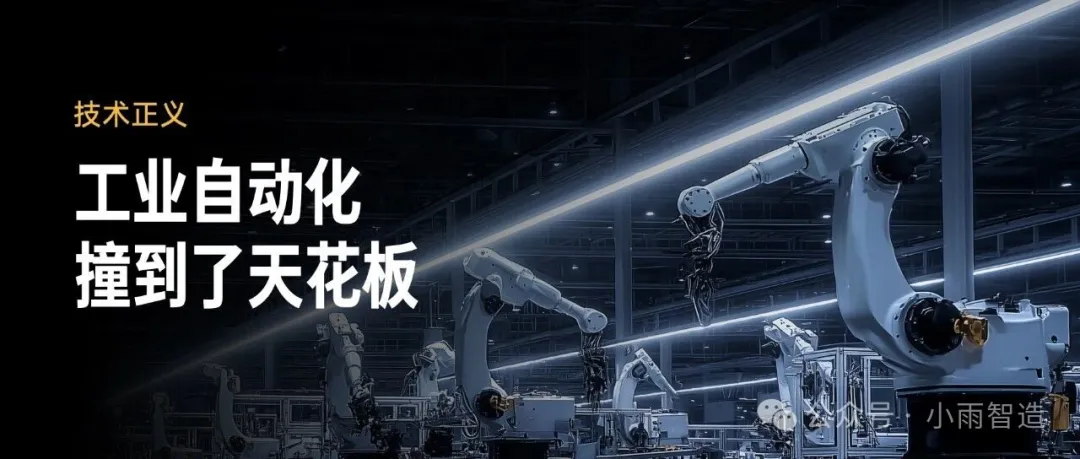
Technological righteousness: crossing the ceiling of automation. Second, from the perspective of technological laws, industrial automation has hit a ceiling. Whether smart factories or lights-out factories, they have to some extent liberated people, but their effect is limited. In fact, only industries with a relatively high degree of standardization can solve problems with automation. Non-standard scenarios are much harder. For example, shipbuilding. Cars can have assembly lines, but how can a giant ship be built on an assembly line? Phones can have lights-out factories, but how can a shipyard dock do that? And thinking a bit further: in the future, when we build space cities and moon bases, how will we do welding? If humanity is to leave Earth, are our current productive forces up to it? It is hard to imagine that when humanity has the capability for interstellar colonization, there would still be a large amount of work requiring human participation. Automation appears powerless in the face of unstructured, dynamic scenarios and higher productivity demands. What industry needs is an "embodied brain" with the ability to cognitively grasp the 3D physical world, able to autonomously observe, understand and adapt to complex environments. Crossing traditional automation technology and driving the development of productive forces — this is our "technological righteousness."

Strategic righteousness: fortifying the moat of China's intelligent manufacturing. Third, from the perspective of the world situation, China's manufacturing must be made solid. Reviewing the history of globalization, because industry itself is unsuited to human labor, plus capital's profit-seeking and cost-driven nature, manufacturing naturally tends to flow outward. This is almost an objective law; the industrial powers in history, without exception, have all gone through this process. In today's world, we clearly feel that manufacturing concerns a nation's core competitiveness, and even more concerns national security and the people's happy life. So we must never repeat the mistakes of the old industrial nations. But we must admit that the risk of China's industry chain shifting to low-cost regions always exists. The only way to break the deadlock is, through industrial embodied intelligence, to build a "silicon-based" labor army that is tireless and continuously evolving, using the "embodied dividend" to fortify the moat of "China's intelligent manufacturing." Defending the global competitiveness of Chinese manufacturing — this is the "strategic righteousness" we pursue.
The above is a bit of my thinking since founding Xiaoyubot. To summarize: Xiaoyubot is a general-purpose embodied-intelligence company, and we have chosen industrial embodied intelligence — this right and righteous path — to reach the endgame of general-purpose embodiment. Right now, our goal is to "pilot China's intelligent manufacturing and rebuild the industrial future." We know full well that this goal is grand; a single tree does not make a forest, and it needs academia, industry, investors and partners to walk alongside us. We also look forward to more fellow travelers joining us, practicing our dream through action and jointly creating the future. "The good rain knows its season; when spring comes, it brings life." Just as spring rain moistens things silently, we do not pursue the loud and spectacular; we would rather be the "timely rain" that nourishes the growth of general-purpose embodied intelligence, going toward our mission with our original aspiration, and together with all fellow travelers, setting out on a brand-new journey for China's intelligent manufacturing. We look forward to meeting in an even better future.